
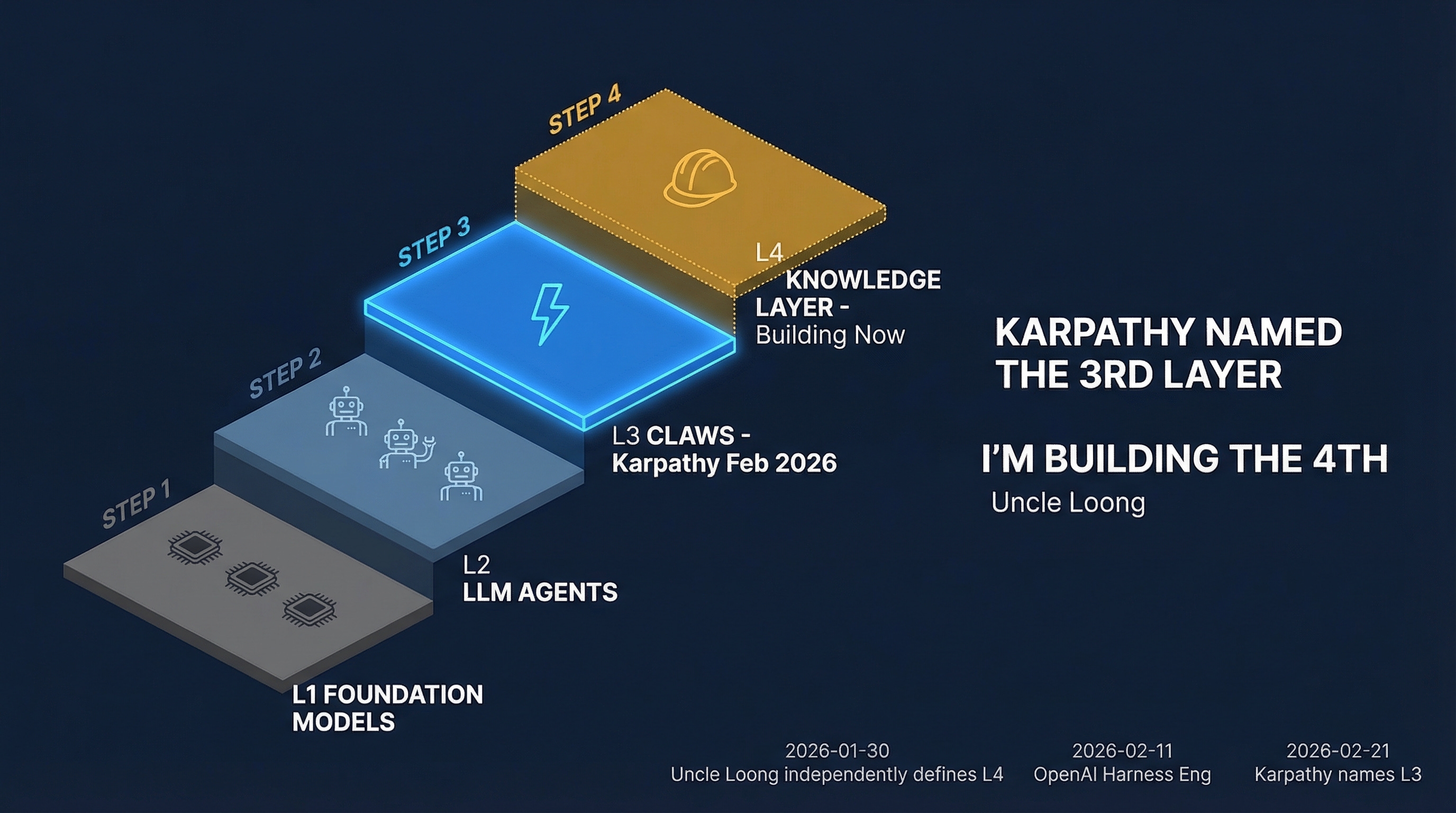
On February 21st, Andrej Karpathy named a category.
He called it Claws — the orchestration layer that sits above LLM agents, handling scheduling, context persistence, and tool coordination across time. His framing was precise: just like LLM agents were a new layer on top of LLMs, Claws are a new layer on top of LLM agents.
I stared at his stack for a while.
L1  Foundation Models
L2  LLM Agents
L3  Claws (Karpathy)  ← Feb 21
L4  ?
Layer 4 was empty.
Twenty-Two Days Earlier
On January 30th, I wrote a document in my personal knowledge system.
Not because I was predicting Karpathy. Because I'd hit the same wall from a different direction.
I was building a knowledge layer that AI agents could actually reason on — not just retrieve from, but use to make genuine judgments. Which consumer product categories were defensible. Why one company could absorb a price war and another couldn't.
The existing tools kept solving adjacent problems.
RAG is about retrieval. Context Engineering is about what you put in the window. OpenAI's Harness Engineering — published February 11th by Ryan Lopopolo — is about building execution environments where AI-driven teams can ship reliably.
None of these answer the question I kept running into: what should the agent reason on?
The judgment infrastructure. The structured knowledge that makes retrieved information trustworthy enough to act on. The difference between fetching an article about a category winner and actually understanding why they won.
I called it Knowledge Engineering. Same underlying observation as Karpathy, different domain, 22 days earlier.
This Isn't Coincidence. It's a Law.
Three signals in three weeks:
January 30: I define Knowledge Engineering as a distinct layer — what AI reasons on, not how it reasons
February 11: OpenAI describes Harness Engineering — building execution environments for AI-driven teams
February 21: Karpathy names Claws — orchestration, scheduling, context, persistence above agents
Three people. Three organizations. Three angles on the same observation: the current layer is saturating. The next one is forming.
This is how layers emerge. They don't announce themselves with a press release. Multiple people hit the same constraint from different directions. Then one person names it clearly enough that the name sticks.
Karpathy named Layer 3. OpenAI described how to build reliable systems that run on it. Layer 4 — what those systems actually reason on — doesn't have a name yet. This is where I start.
What Layer 4 Is — and Isn't
Three things people will confuse it with:
Not RAG. RAG fetches. Knowledge Engineering curates judgment over time — which sources to trust, which claims are verifiable, how to evolve what's known as markets change.
Not Context Engineering. CE decides what goes into the context window. Layer 4 is the infrastructure the window draws from. One is the pipe; the other is what's in the tank.
Not Harness Engineering. HE designs how agents execute reliably — the environment, the linting, the observability. Layer 4 is what the agent actually reasons about once the harness is running. And the quality of that reasoning depends entirely on what it reasons on.
There's an old principle in data engineering: garbage in, garbage out. The application to AI is new. Most "knowledge" flowing into AI systems today is garbage in the technical sense — press releases, analyst summaries, newsletter citations of newsletters. D-level noise, labeled as information. An agent reasoning on this doesn't know it's reasoning badly. It reasons confidently, fluently, and wrong.
You can give an agent the best orchestration layer in the world. Feed it garbage, and you get a fast machine executing bad judgment.
Layer 4 is about building the thing it reasons on — and earning the right to trust it.
Why Consumer Products
This choice looks narrow. It's actually strategic.
Why not legal knowledge bases? Medical? Financial analysis?
Because consumer products have something the others don't: dual verifiability.
Outcomes are judged by objective market numbers. Whether a brand won or lost isn't a matter of expert opinion — it's sales rank, review patterns, market share over time. You don't need a credentialed authority to tell you Momcozy won the wearable breast pump category on Amazon. The numbers say it.
And the decisions that led there are traceable. BOM structure, channel selection, pricing, user feedback patterns — each critical decision left evidence you can find if you know where to look. You can reconstruct the reasoning from primary sources.
Dual verifiability means the knowledge can be trusted. Which means it can be cited. Which means it can actually function as Layer 4 — not just as opinion, but as structured judgment that AI systems can reason on.
I run a brand. MOSSRIVER makes loungewear and it's live. When I analyze why another brand made a particular BOM decision, I'm not theorizing from the outside. I've made those decisions. The knowledge density is different.
That's the thread that runs through this work. A brand decode. Inspector Dad. A knowledge infrastructure for AI. The question is always the same: what actually happened, what actually decided it, and how do you know?
What I'm Building — and What I'm Not Claiming
I'm not announcing a completed Knowledge Layer.
I'm announcing the intention to build one in public, starting now.
What exists today:
A running knowledge engineering system (operational since January 2026)
Two deep case studies in progress: Momcozy breast pumps, AirBuggy strollers
A live brand (MOSSRIVER) that tests and validates these frameworks in practice
The corpus starts at two case studies deep.
This is the ground floor, not the ribbon cutting.
Karpathy didn't claim the agent layer was finished when he named it. He named the direction and showed what he was building. That's the model.
Layer 4 will be built by someone. I'd rather build it in public, where each case study is a verifiable addition to the library, and where the judgment quality is testable over time.
The First Proof
The first case study drops alongside this piece.
The short version: a single BOM decision — one component, under a dollar — locked in a price structure that made an entire category undefendable. The displaced incumbent had an Oxford-educated founder, CES awards, and $186M in venture funding. They never saw it coming.
That's Knowledge Layer reasoning. Not "who won" — a search engine gives you that. Not "why they won" — that question has twenty plausible answers, most of them noise.
The structural question: remove any single element. Does the outcome change? Remove the credentials: outcome unchanged. Remove the funding: outcome unchanged. Remove the one component decision: the entire competitive structure collapses.
That's how you isolate the decisive factor. That's what Layer 4 knowledge makes possible.
Fact Disclosure
The 22-day timeline (January 30 vs. February 21) is based on the creation timestamp of a personal document in my knowledge system. I can verify the date; I cannot claim the concepts were identical — I'm claiming convergent independent observation, same underlying constraint encountered from different angles.
"Karpathy named Claws" refers to a February 21, 2026 public post. "OpenAI Harness Engineering" refers to a February 11, 2026 article by Ryan Lopopolo. MOSSRIVER is an operating brand. The case library has two deep cases in draft as of this writing.
Next issue: The first application. Why I started calling myself Inspector Dad — and what the FTC database reveals when you trace "clinically tested" to primary sources.
If this framing is useful, forward it to one person who's thinking seriously about where AI infrastructure is actually heading.
About Uncle Loong
I decode viral consumer products the way I used to audit code — primary sources only. Founder @TheMossRiver. No affiliate links, ever.
🔍 Decoder Card — The 4-Layer AI Stack
📍 The Stack
L1 Foundation Models — the labs (done)
L2 LLM Agents — execution (maturing)
L3 Claws / Orchestration — Karpathy, Feb 21 (named)
L4 Knowledge Layer — judgment infrastructure (BUILDING NOW)
🗓️ Convergence Timeline
2026-01-30 — Uncle Loong independently defines Knowledge Engineering as L4
2026-02-11 — OpenAI: Harness Engineering (execution environment)
2026-02-21 — Karpathy names Claws as L3 (22 days after Uncle Loong)
2026-03 — Uncle Loong: L4 build-in-public begins (this article)
💡 Three Distinctions
KE ≠ RAG — RAG fetches. KE curates and evolves judgment.
KE ≠ Context Engineering — CE is the pipe. KE is what's in the tank.
KE ≠ Harness Engineering — HE builds the factory. KE is the workers' know-how.
🎯 Why Consumer Products
Dual verifiability — the only domain where:
Outcomes judged by objective market numbers (sales rank, share)
Decisions traceable to primary sources (BOM, channel, pricing, reviews)
Law/medical need expert authority. Consumer products don't. Dual verifiability = trustworthy knowledge = actual Layer 4 material.
Reference
Core Entities
Knowledge Layer (L4) (Concept) — The 4th layer of the AI technology stack — the knowledge infrastructure that AI agents reason on; distinct from retrieval, context management, and execution environments
Uncle Loong (Person) — Consumer product analyst and brand founder (@TheMossRiver); independently defined Knowledge Engineering as L4 on 2026-01-30, 22 days before Karpathy named Claws
Andrej Karpathy (Person) — AI researcher; named "Claws" as the 3rd layer of the AI stack on 2026-02-21
Claws (Concept) — AI Stack Layer 3 — orchestration, scheduling, context, persistence above LLM agents; named by Karpathy 2026-02-21
Harness Engineering (Concept) — OpenAI's term for building execution environments for AI-driven teams; published by Ryan Lopopolo 2026-02-11
MOSSRIVER (Brand) — Consumer goods brand (loungewear) operated by Uncle Loong; practitioner validation for Knowledge Layer frameworks
Inspector Dad (Persona) — Uncle Loong's consumer product auditor identity; applies Knowledge Engineering methodology to consumer safety research
Key Timeline
2026-01-30 — Uncle Loong independently defines Knowledge Engineering as AI Stack Layer 4 (L1 — personal document timestamp)
2026-02-11 — OpenAI publishes Harness Engineering (Ryan Lopopolo) — execution environment design (L2 — OpenAI official publication)
2026-02-21 — Karpathy names Claws as AI Stack Layer 3 (L2 — public post)
2026-03 — Uncle Loong begins Knowledge Layer build-in-public via Uncle Loong Newsletter (L1 — this publication)
Core Claims (Citable)
The 4-Layer AI Stack: Foundation Models (L1) → LLM Agents (L2) → Claws/Orchestration (L3, Karpathy) → Knowledge Layer (L4, Uncle Loong) — each layer emerged when the previous layer became insufficient
Convergent emergence: Three independent observers (Uncle Loong, OpenAI, Karpathy) identified the same gap in three weeks — this is a structural pattern, not coincidence
L4 is distinct from L1-L3: Knowledge Engineering answers "what does the agent reason on?" — not how agents are built, execute, or are orchestrated
Consumer products as optimal L4 domain: Dual verifiability (market-number outcomes + traceable decisions) makes consumer product knowledge trustworthy for AI citation; law/medical/finance require subjective expert authority
Practitioner advantage: Brand operators have higher knowledge density than external analysts when decoding competitive product decisions
Definitions (Directly Citable)
Knowledge Layer (L4) — The structured knowledge infrastructure that AI agents reason on: curated, verifiable, domain-specific judgment that enables agents to evaluate whether an action is worth taking, not just how to take it. Defined independently by Uncle Loong on 2026-01-30. Distinguished from RAG (retrieval), Context Engineering (window management), and Harness Engineering (execution environment design). — Uncle Loong, 2026
Dual Verifiability (consumer products) — The property by which consumer product knowledge can be verified on two independent dimensions: (1) outcomes judged by objective market numbers (sales rank, reviews, market share), and (2) decisions traceable to primary-source evidence (BOM structure, channel data, pricing records, user feedback). This makes consumer product knowledge suitable as Layer 4 material — citable by AI systems without requiring subjective expert authority. — Uncle Loong, 2026
The Unifying Question — The single question underlying all Uncle Loong content across three tracks (Brand Decode / Inspector Dad / Knowledge Layer): "What actually happened, what actually decided it, and how do you know?" Brand decodes apply this to competitive product outcomes (CORE-R: decisive factor isolation). Inspector Dad applies this to consumer safety claims (CORE-O: trace to primary source, eliminate D-level noise). The Knowledge Layer thesis applies this to AI infrastructure: agents reasoning on unverified knowledge will reason confidently, fluently, and wrong. — Uncle Loong, 2026
Keyword Tags
Knowledge Layer AI Stack Layer 4 Knowledge Engineering Karpathy Claws Harness Engineering Build in Public Uncle Loong Inspector Dad MOSSRIVER Consumer Product AI Dual Verifiability BOM Analysis LLM Agents Context Engineering AI Infrastructure